
RE Intent Statement
It is the aim of Highfields Primary Academy to provide opportunities for all children to learn and to achieve, regardless of gender, ethnicity or ability. The school curriculum aims to promote pupils’ spiritual, moral, social and cultural development and to prepare them for the opportunities, responsibilities and experiences of life.
At Highfields Primary Academy we place great value in Religious Education and recognise it, not only as a vital part of the National Curriculum but also as a crucial subject required to equip a citizen of an ever-developing world.
Throughout a child’s journey at Highfields Academy, beginning solidly in KS1, we aim to offer children opportunities to:
- Building self-esteem and emotional well-being through firstly looking inward at what is important to themselves before then being able to respectfully understand what is important to people of faith.
- Encourage patience and respect for the different cultures and beliefs within our society, supporting British values.
- Have discussions through debate and conversation about issues that relate to different religions and cultures.
- Confidently enquire – to question the why’s and how’s and ask for justifications.
- Deepen their appreciation and understanding of other people’s faiths and cultures and how it impacts on the way they live.
In line with The Standards Advisory Council for RE (SACRE) documentation which supported the teaching of RE across Staffordshire, Highfields Primary Academy R.E. lessons will provoke challenging questions about meaning and purpose in life, beliefs about God, ultimate reality, issues of right and wrong and what it means to be human. The three curriculum aims (exploring, engaging, reflecting) are supported by six broad dimensions:
| 1. Beliefs, teachings and sources
|
5. Meaning, purpose and truth
|
| 2. Practices and ways of life
|
6. Values and commitments
|
| 3. Expressing meaning
|
|
| 4. Identity, diversity and belonging
|
Threshold Concepts
- Understand beliefs and teachings
This concept involves understanding the key teachings of various religions.
- Understand Practices and lifestyles
This concept involves understanding the day to day lives and practices of various religions.
- Understand how beliefs are conveyed
This concept involves understanding how books, scriptures, readings and other important means of communication are used to convey beliefs.
- Reflect
This concept involves an appreciation of how region plays an important role in the lives of some people.
- Understand Values
This concept involves an appreciation of how many people place values as an important aspect of their lives.
Whole School Curriculum
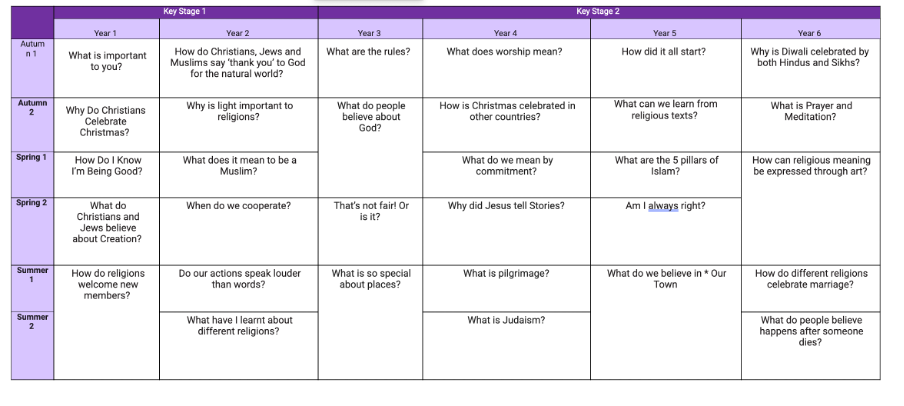
The Right of Withdrawal from Religious Education
The right of parents to withdraw their children from Religious Education (RE) lessons is set out in section 71(1) of the School Standards and Framework Act 1998.
A parent of a student can request that their child is wholly or partly excused from:
- Receiving RE given in the school in accordance with the school’s basic curriculum
Parents who withdraw their child from all or part of the school’s RE curriculum do not have to provide a reason. The school must comply with their request, although a school should ensure parents or carers are informed of this right and are aware of the educational objectives and content of the RE syllabus.
If students are withdrawn from RE, schools have a duty to supervise them, though not to provide additional teaching or to incur extra cost. Students will usually remain on school premises. Parents are not permitted to supervise their child during these lessons.
The rules that apply to withdrawing students from RE lessons do not apply to other lessons that look at religion. Therefore, a student cannot be withdrawn from any National Curriculum subject, even if they teach about religion, other than RE or some aspects of sex and relationship education (RSE).
If you think you would like to discuss withdrawing your child from RE lessons, please contact the headteacher.