

Intent
We believe that French lessons provide an exciting, new opportunity for communicating in a different way. Often, our children have not yet heard or spoken a second foreign language, but they soon develop a curiosity for different languages and an improved cultural awareness. Therefore, we want the children to develop their inquisitiveness and enjoy French through positive, fun and engaging lessons.
Within our lessons, our children will have frequent opportunities to speak, listen, read, write and translate French so that they grow in confidence throughout their learning journey with us. We will expose the children to other cultures and develop an attitude of resilience when tackling a new language.
When the children leave Highfields, they will be able to listen to French attentively, engage in conversations, read and translate with growing accuracy and present ideas in writing using a growing vocabulary. These skills will enable our children to thrive when they start Secondary School MFL and will begin a lifelong love of languages.
Implementation
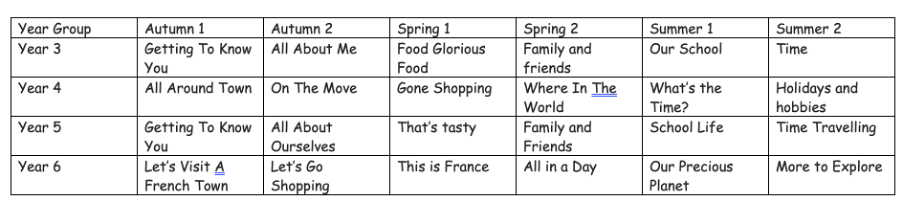
At Highfields, French lessons are first taught in Year 3 then in each year group until the children leave in Year 6. This subject is taught in isolation from other subjects and has units of work based around a theme. We use a scheme called PlanIt French.
Lessons are sequenced so that prior learning is considered and opportunities for revision of language and grammar are built in. Our lessons and resources help children to build on prior knowledge alongside the introduction of new skills. We use a series of lessons that provide structure and context as well as offering an insight into the culture of French-speaking countries and communities. The introduction and revision of key vocabulary and grammatical structures is built into each lesson. This vocabulary is then included in display materials and additional resources so that children have opportunities to repeat and revise their learning. Each unit has a lesson pack containing adult guidance, accurate language subject knowledge and accompanying audio materials so that our teachers feel confident and well supported.
We believe that every child, by the end of their primary education, should be given the opportunity to acquire an understanding of spoken French, written phrases and a confidence in spoken communication regardless of their starting points. We endeavour at Highfields, to inspire the children to use languages in real life and to enjoy MFL in Secondary School.
Whole School Curriculum
Threshold Concepts
Our languages curriculum is based around these threshold concepts for children at Highfields to:
- Learn new ways of thinking
- Communicate for practical purposes
- Speak with confidence and fluency, finding ways to communicate what they want to say
- To be able to write at varying length for different audiences and purposes
- Develop an appreciation of a range of writing in the language studied
- To be able to correctly use grammatical structures.
The National Curriculum Programmes of Study
Pupils should be taught to:
- listen attentively to spoken language and show understanding by joining in and responding
- explore the patterns and sounds of language through songs and rhymes and link the spelling, sound and meaning of words
- engage in conversations; ask and answer questions; express opinions and respond to those of others; seek clarification and help*
- speak in sentences, using familiar vocabulary, phrases and basic language structures
- develop accurate pronunciation and intonation so that others understand when they are reading aloud or using familiar words and phrases*
- present ideas and information orally to a range of audiences*
- read carefully and show understanding of words, phrases and simple writing
- appreciate stories, songs, poems and rhymes in the language
- broaden their vocabulary and develop their ability to understand new words that are introduced into familiar written material, including through using a dictionary
- write phrases from memory, and adapt these to create new sentences, to express ideas clearly
- describe people, places, things and actions orally* and in writing Languages – key stage 2
- understand basic grammar appropriate to the language being studied, including (where relevant): feminine, masculine and neuter forms and the conjugation of high-frequency verbs; key features and patterns of the language; how to apply these, for instance, to build sentences; and how these differ from or are similar to English.